
The Best Free AI Humanizer for CS Students in 2026 (Tested on Lab Reports and READMEs)

So here’s the thing about free AI humanizer tools that nobody tells you before you actually need one: they’re all built for essay writers and content marketers. Not for CS students trying to submit a methodology section that explains thread scheduling behavior.
I found this out in the worst way possible.
Semester started, my professor quietly updated the Canvas syllabus two weeks in to include AI detection on all major assignments. No announcement. Just there, buried in a policy update, and I only noticed because someone in my Discord server mentioned it. At that point I already had 600 words of GPT-4 output drafted for my OS lab report and approximately zero backup plans.
I went to Discord, asked what tools people actually use. Got recommendations for Undetectable.ai, HIX.AI Bypass, QuillBot, a few others. All the replies were from people who use these tools for English papers. Nobody writes lab reports in my Discord server apparently. Or at least nobody’s admitting it.
Tried four tools that week. Every single one either truncated my text, watermarked the output, or handed me back something that was factually wrong in ways that would have been obvious to my professor. And still flagging as AI.
ngl at that point I was kind of annoyed. So I just ran a proper test.
The short answer: which free AI humanizer is best specifically for CS technical writing, like lab reports, methodology sections, and documentation-heavy assignments? After running the same 500-word methodology section through four tools and checking every output with the same AI detector: Walter Writes scored best (19% AI detected by Proofademic, no watermark, no credit card, 1-click Google login), HIX.AI Bypass was second (27%), Undetectable.ai came in at 34%, and QuillBot was basically useless for this purpose (76%). The catch is Walter Writes caps you at 300 words on the free tier, same as most others. For anything longer, you’ll need to upgrade somewhere.
Why free tools specifically fall apart for CS writing
There are two problems, not one.
The first is word limits. Undetectable.ai truncates at 250 words on the free tier. WriteHuman at 200. HIX.AI gave me what looked like a trial run, maybe 500 words. QuillBot is technically unlimited. For a 150-word discussion post, these limits don’t matter. For a 1,500-word lab report, you’re either chopping the assignment into chunks and processing them separately (losing coherence at the joins) or you’re upgrading.
The second problem is vocabulary, and this is the one that actually matters for CS writing. What these tools do is replace technical terms with generic synonyms. “The algorithm iterates over the linked list” turns into “the process moves through the data sequence.” That output (a) sounds like a middle school science explanation, (b) is technically imprecise, and (c) will read as wrong to a professor who actually knows the subject.
And there’s a third thing I didn’t think about until I ran the test: calibration. Most free humanizers are tuned specifically to pass GPTZero or Originality.ai on general prose. Academic CS writing behaves differently. A sentence like “The scheduler assigns CPU time using a round-robin algorithm with a 10ms time quantum” looks like AI output to a lot of detectors even when a real student wrote it, because dense formal technical sentences share patterns with LLM-generated text. General humanizers often make this worse, not better. They rewrite technically correct sentences into vaguer phrasing that still flags, just for different reasons.
So you end up with output that’s less accurate and still detected. It is what it is.
And this is specific to CS students. If you’re in an English class, a free humanizer swapping “utilizes” for “uses” is probably fine. If your professor is checking that your methodology section correctly describes your experimental setup, factual accuracy matters. You can’t just paraphrase “kernel 5.15” into “the system software” and call it humanized.
The test to find the best free humanizer
Input: a 500-word OS lab methodology section. Thread scheduling behavior, Ubuntu 22.04 test environment, kernel 5.15, and the metrics I was tracking. Dense and technical, exactly the kind of text where these tools struggle.
Ran it through: Undetectable.ai, QuillBot, HIX.AI Bypass, WriteHuman. Free tiers on all of them.
For detection I used Proofademic on every output, same settings every run. I picked Proofademic over GPTZero or the Turnitin student check specifically because it returns sentence-level scores. One overall percentage doesn’t tell me which sentences to actually fix.
Tool Free word limit Watermark Credit card needed Proofademic score Technical vocab preserved Notes Walter Writes 300 words No No 19% AI Yes Best score; structure-level rewrite, not synonym swapping. 1-click Google login Undetectable.ai 250 words Yes No 34% AI Partially Truncated at 250 words; second half unprocessed HIX.AI Bypass ~500 words (trial) No No 27% AI Partially Good score but swapped technical terms, including factual errors QuillBot Unlimited No No 76% AI Yes Paraphraser, not a humanizer — patterns still flagged
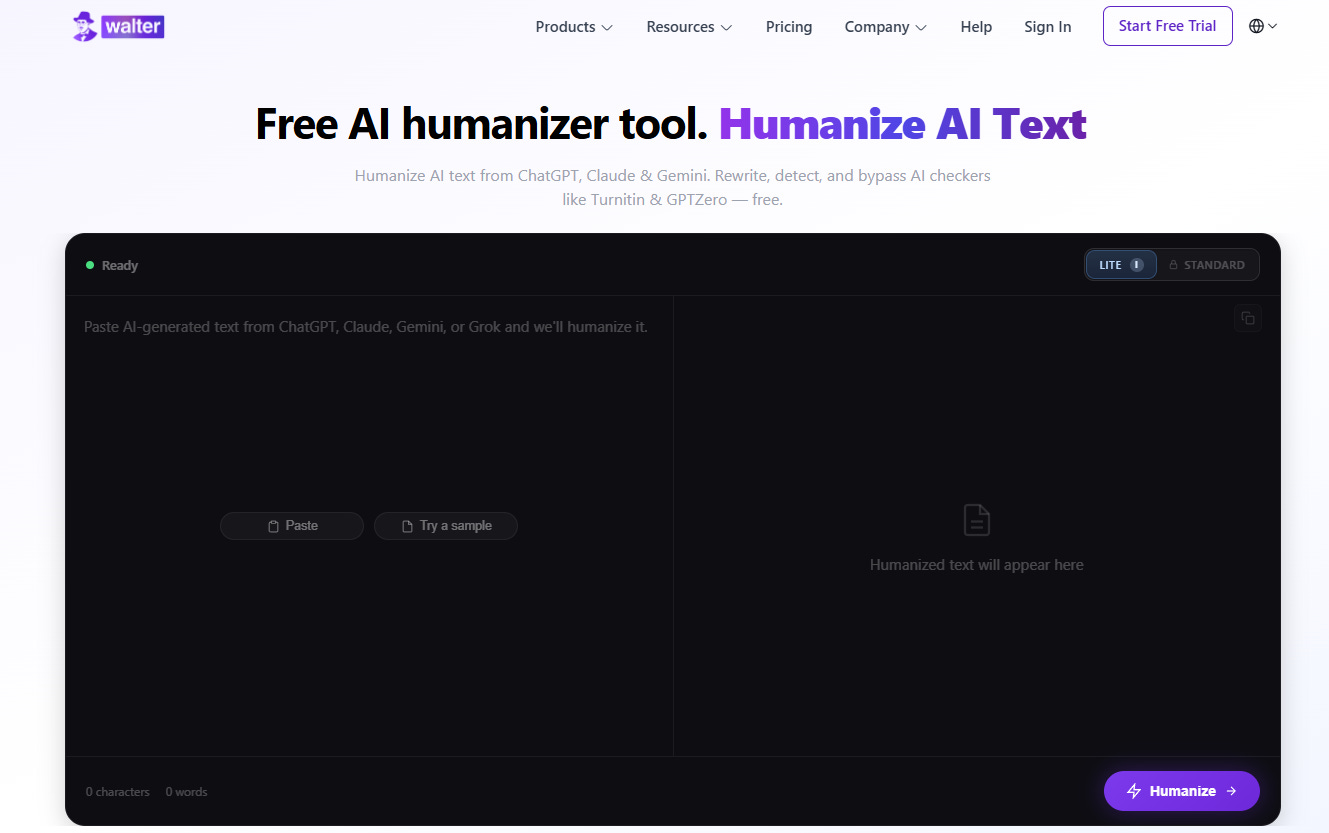
Walter Writes was the one I should have started with, honestly. Free tier is 300 words, no watermark, no credit card, and you can sign in with Google in one click — no account setup. The detection score was the best of the four, and more importantly it didn’t touch my technical terms. “Round-robin algorithm” stayed “round-robin algorithm.” The student humanizer page specifically calls out academic writing, which tracks — it’s doing structure-level rewriting, not just synonym swapping. The 300-word limit is still a problem for anything longer than a short section, but for what the free tier is, it’s the most useful.
HIX.AI came close on detection but changed “memory address range” to “storage location boundaries.” Not accurate, and any OS professor would notice. Undetectable cut off at 250 words so I was stitching two processed chunks together by hand, which was a mess at the joins.
QuillBot. My CS Discord talks about it like it’s the answer to everything. 76% AI. Almost as high as the raw GPT-4 text I started with. This happens because QuillBot is a paraphraser: it changes words and rearranges phrasing, but it doesn’t touch the cadence and rhythmic patterns that detection models specifically look for. Paraphrasing is not humanizing. QuillBot is good at one of those things.
The part that actually surprised me
Every other detector I tested gives you one number and a color. Fine for knowing whether to worry, useless for knowing what to fix.
Proofademic’s sentence-level detection works differently. You see exactly which sentences flagged and get an explanation of why each one triggered. For technical academic writing this matters a lot, because dense formal sentences, the kind any CS student would actually write, register as AI on most detectors just because of their structure. Proofademic is trained specifically on academic writing patterns, so it’s better at separating “sounds like AI” from “sounds like a technical paper.” Fewer false flags on stuff you actually wrote, more accurate flagging on the patterns you need to change.
What that looked like in practice: I ran the HIX.AI output through Proofademic and saw it was four specific sentences, the ones HIX had softened into generic filler, that were still scoring high. Fixed those four manually in about ten minutes instead of rewriting the whole section blind.
Lowkey the sentence-level breakdown was the most useful tool in this whole test.
READMEs are a different problem
This is worth calling out because I confused these two problems for a long time.
Lab report submissions: Turnitin is running on your professor’s end. The risk is real. Get flagged, deal with an academic integrity process, potentially fail the assignment. I take that seriously now.
GitHub READMEs: nobody’s running your repo through Turnitin. The problem there is that GPT-4 README voice is recognizable. “This project implements X. This application provides Y. Users can Z.” I had this on every one of my early repos and didn’t notice until a friend pointed it out while reviewing my portfolio before internship season. That phrasing is everywhere. Recruiters have seen it a thousand times.
Free humanizers don’t solve this either. They reduce AI probability scores. They don’t add personality or developer voice. A README that reads generically is still a problem even with a lower detection percentage.
What actually makes a README feel like it came from someone who built the project is specificity: the specific edge case you ran into, your opinion on an architectural call, the thing you’d do differently if you started over. That’s hard to automate. For READMEs under 300 words, a humanizer pass plus manual edits works okay. Anything longer with real architecture content, write those sections yourself. The boilerplate can be AI. The parts where a developer would have an actual opinion shouldn’t be.
I started keeping a one-paragraph notes doc for each project while I’m building it, just whatever comes to mind about why I made certain calls or where I got stuck. Takes maybe two minutes. When the project is done, those notes go into the README and they actually sound like me. It’s a stupid simple fix but it works better than any tool I’ve tried.
So what’s actually worth using - the best free humanizers
For assignments under 300 words: Walter Writes free tier is the move. No credit card, no watermark, 1-click Google login, and it actually preserves technical vocabulary. Run the output through Proofademic’s free trial before you submit. Three minutes. It’ll tell you which specific sentences still need work. Most people skip the detection check and just hope. Don’t skip it.
For anything over 300 words: you’re paying for something somewhere. That’s just the honest answer. Free tiers aren’t designed to handle a full CS lab report.
The tools worth paying for are the ones that keep your technical vocabulary intact, let you adjust rewrite intensity, and include detection built in so you’re not bouncing between three different tabs. Walter Writes has paid tiers starting at $8/month that give you up to 30,000 words per month with the same structure-level rewriting. For a CS student submitting multiple assignments a semester, that math works out.
My current setup: draft in GPT-4, run through a humanizer at enhanced strength, check the output in Proofademic sentence by sentence, fix whatever’s still flagging, submit. Not fast. But it’s held up every time I’ve used it this semester, and I haven’t had a detection flag.
If you’ve found something that handles CS technical writing better than this, hit reply. I’m genuinely trying to tighten this workflow up.